I.Introduction: Press Brake – The Soul of Sheet Metal Fabrication
A press brake is a machine specifically designed to bend metal sheets into various shapes. Simply put, it acts as an “industrial paper folder”: you insert a flat metal sheet, and the machine uses top and bottom tools (dies) to press it into L-shapes, U-shapes, or more complex forms. It is the essential tool for making metal cabinets, door frames, brackets, and all types of metal enclosures.
II. In-depth Breakdown: The 5 Core Components of a Press Brake
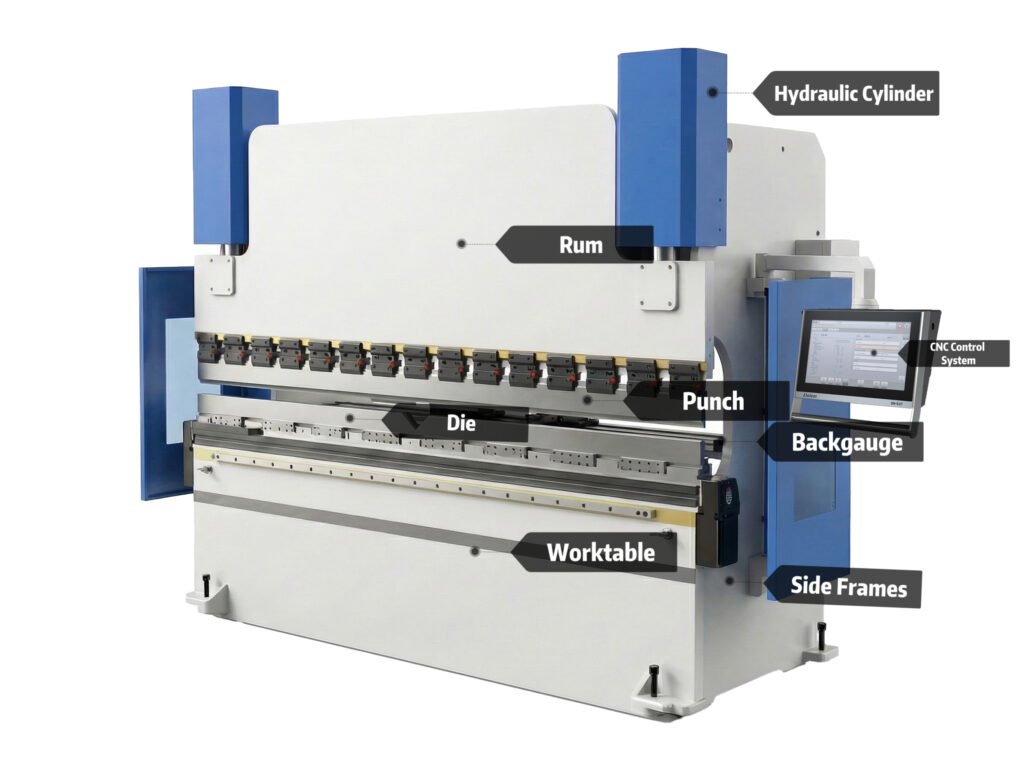
To understand how a press brake operates, one must first recognize the five primary systems that make up the machine. Each component is located in a specific area and serves a critical function in the bending process.
1. The Frame Structure
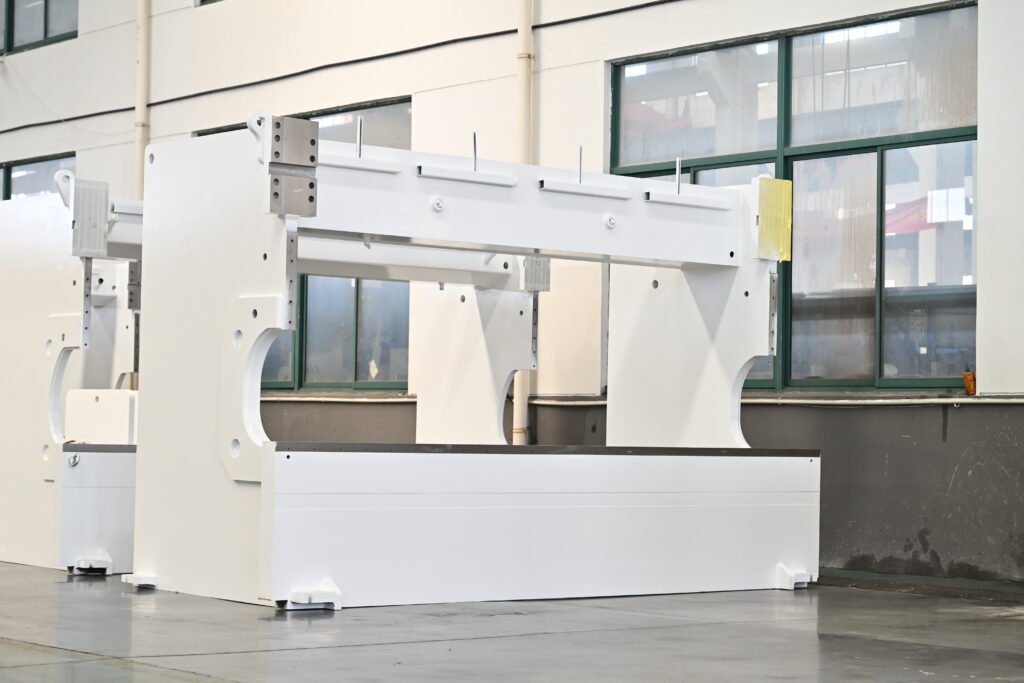
Physical Location: The massive steel main body that supports the entire machine, including the side frames, the bed (worktable), and connecting beams.
The Role: It provides the high-rigidity foundation for all moving parts. The stability of the frame is the prerequisite for every micron of precision.
2.The Ram & Hydraulic Driving System
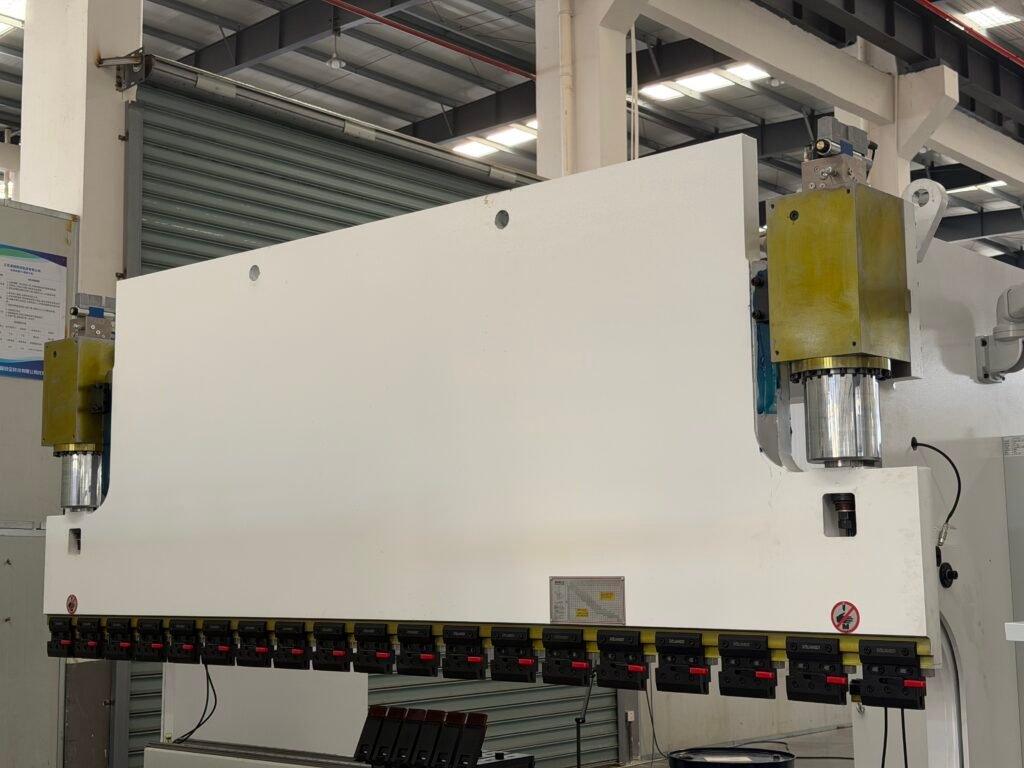
Physical Location: Located at the top of the machine, consisting of large hydraulic cylinders and the horizontal moving beam (the Ram).
The Role: This system serves as the primary power and execution unit of the press brake. By utilizing a servo motor to drive a high-pressure oil pump, hydraulic fluid is precisely delivered to the cylinders on both sides, forcing the ram to generate the vertical downward tonnage required for bending. This system is the fundamental determinant of the machine’s bending capacity (plate thickness) and its overall cycle efficiency (operational speed).
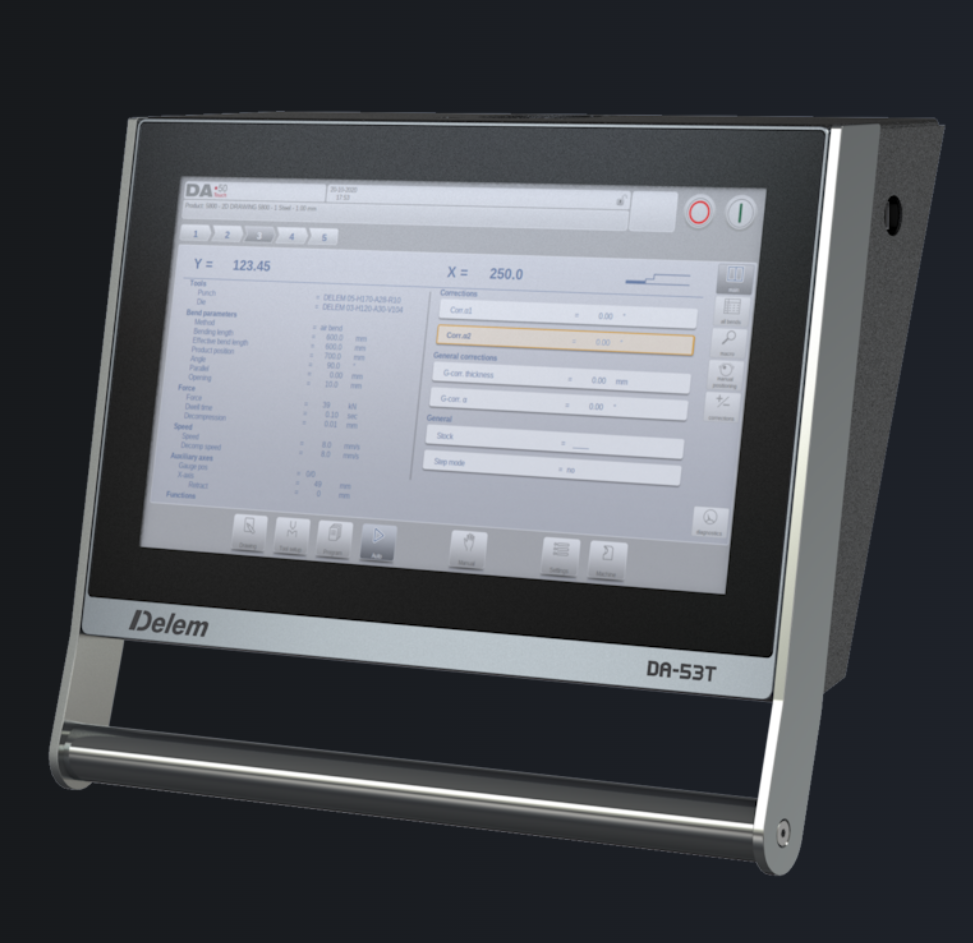
3. The CNC Control System
Physical Location: Usually mounted on a swiveling arm on the side of the machine, featuring an industrial touchscreen interface (e.g., Delem, ESA, or Cybelec).
The Role: This is a specialized computer that calculates bending sequences, pressure compensation, and the exact positioning of every axis. It digitally coordinates every movement of the machine. It is the core of high-efficiency production and automated processing.
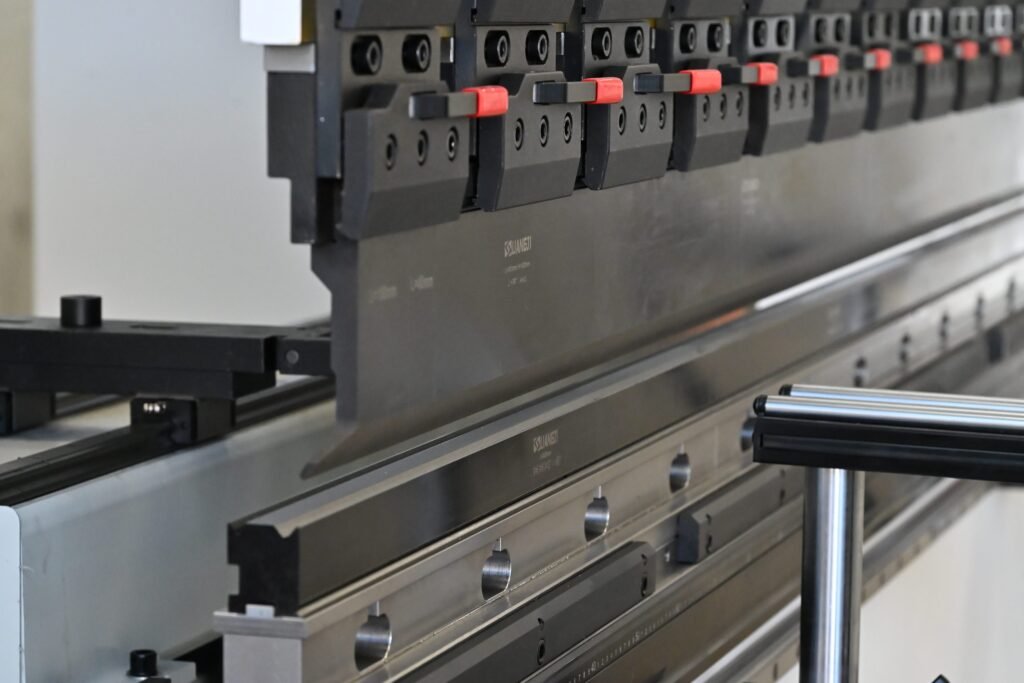
4. The Tooling System: Punch & Die
Physical Location: Located in the center working area—the Punch is attached to the bottom of the ram, and the Die is secured on the worktable.
The Role: The Punch (Upper Tool): Available in various shapes (e.g., gooseneck, straight) to press into the metal. The Die (Bottom Tool): Features V-shaped openings of different widths to determine the bend radius. The tooling is the direct interface with the metal sheet. Its precision and material hardness directly dictate the final quality of the bend.
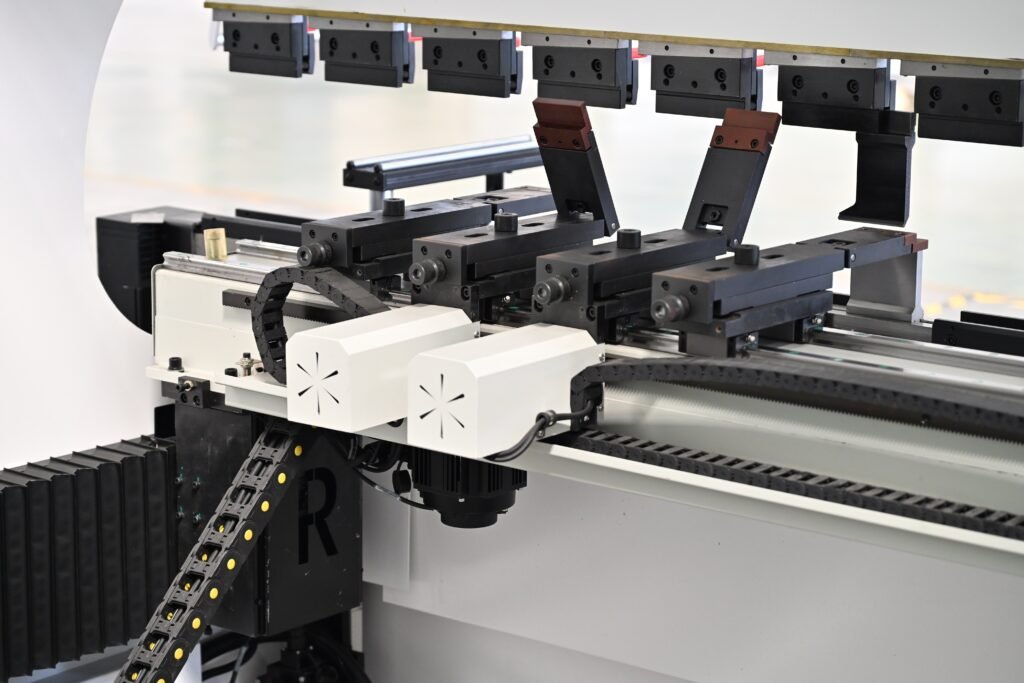
5. The Backgauge System
Physical Location: Located at the rear of the machine, behind the tooling area.
The Role: A high-precision mechanism consisting of rails, ball screws, and “fingers” (stops). It typically moves along multiple axes (X-axis for depth, R-axis for height). When the operator slides a metal sheet into the machine, the backgauge fingers stop the sheet at the exact position. It ensures dimensional consistency, answering the critical question: “Where exactly should the bend occur?”
III. Core Operating Principles: Power & Precision
Understanding the mechanics of a press brake involves two main stages: how the force is generated and how the metal is actually formed.
1. Pressure Generation and Transmission
The process begins with the generation of massive force, which must be delivered with extreme control.
- Hydraulic Drive (The Modern Standard): In a servo-hydraulic system, a high-efficiency motor drives an oil pump, sending pressurized hydraulic fluid into the dual cylinders at the top.
- The Transmission: This hydraulic pressure forces the Ram (the horizontal beam) to move downward. By using servo-valves to regulate the oil flow, the machine can stop the ram with a precision of ≤0.01, ensuring the pressure is applied exactly where and when it is needed.
- Key Advantage: Unlike mechanical drives, hydraulic systems allow for full pressure throughout the entire stroke and can be adjusted based on the specific thickness of the metal plate.
2. The Forming Process: Three-Point Bending
Once the pressure is generated, the physical transformation of the metal occurs through a mechanism known as “Three-Point Bending.”
- The Action: The Punch (upper tool) moves vertically into the V-opening of the Die (bottom tool) with the metal sheet positioned between them.
- Three-Point Contact: As the punch descends, the metal sheet is supported at exactly three points: the two top edges of the V-die and the single tip of the upper punch.
- Plastic Deformation: As the punch continues to press downward, the metal is forced beyond its “elastic limit.” It undergoes plastic deformation, meaning the molecular structure of the metal is permanently reshaped to match the angle determined by the depth of the punch’s stroke.
- The Result: By controlling how deep the punch enters the V-die, the CNC system can produce any angle with absolute consistency across the entire length of the part.
IV. Comparison of Mainstream Press Brake Types
To choose the right equipment, it is essential to understand the different technical schools of press brakes:
- Torsion Bar Sync Press Brake :
- Features: Uses a mechanical shaft to force synchronization of the cylinders.
- Application: Cost-effective and durable; ideal for general processing with standard precision requirements.
- Electro-Hydraulic Sync Press Brake :
- Features: Uses CNC-controlled servo valves and optical scales for real-time synchronization. Supports off-center loading.
- Application: Extremely high precision; the best choice for complex workpieces and high-end manufacturing.
- All-Electric Servo Press Brake :
- Features: Driven entirely by servo motors without a hydraulic system.
- Application: Eco-friendly, high speed, and ultra-high precision (perfect for small, precision parts).
V.Conclusion: The Future of Bending Technology
The industry is moving beyond simple manual operation. The future of the press brake lies in Automation and Intelligence. These advancements allow for 24/7 production with zero defects.
If you are looking for the right bending solution for your project, or need expert technical advice, please feel free to contact us. Let’s build the future of manufacturing together.