
1. Introduction
In the electro-hydraulic press brake system, bending accuracy is mainly affected by machine frame deflection.
During high-tonnage bending operations, even a high-rigidity electro-hydraulic press brake will experience slight deformation, which can affect the final part accuracy.
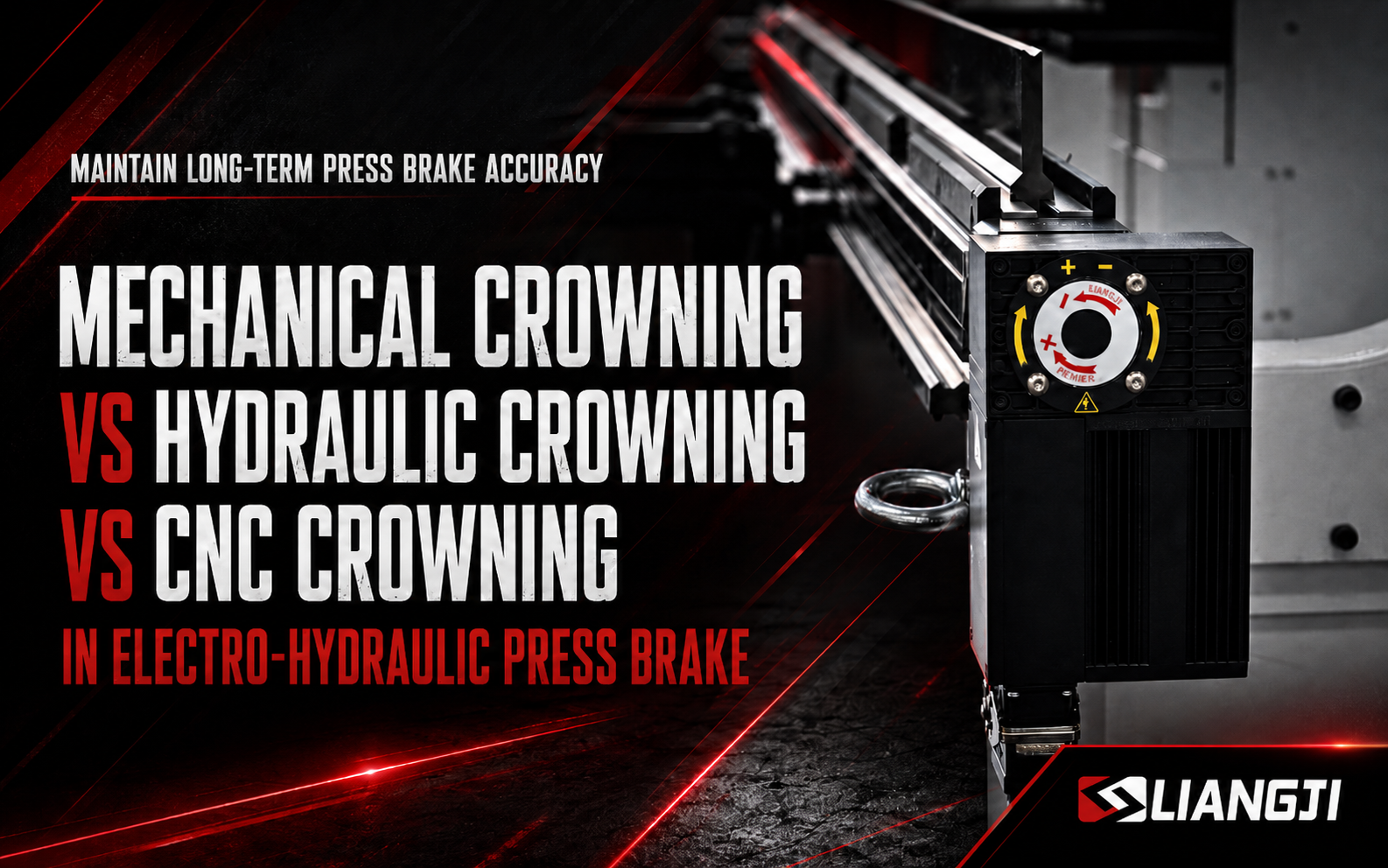
Therefore, electro-hydraulic press brakes typically adopt different types of crowning systems, including mechanical crowning, hydraulic crowning, and CNC crowning, each offering different performance in terms of accuracy, cost, and maintenance requirements.
2. What Is a Crowning System?
During the operation of an electro-hydraulic press brake, bending force is typically applied by hydraulic cylinders on both sides of the machine. Due to the force transmission path, the load is usually higher at both ends of the workpiece and relatively lower in the middle, which can result in slight deviations in bending angles across different positions.
The function of a crowning system is to apply a counteracting force through the worktable or frame structure to compensate for natural machine deflection. This helps the electro-hydraulic press brake maintain a more uniform force distribution under load, ensuring consistent bending angles and forming accuracy.
In high-tonnage electro-hydraulic press brakes, this uneven force distribution becomes more pronounced. Therefore, crowning systems are especially important and widely used in medium and heavy-duty machines as a key structure for maintaining processing stability.
3. Three Types of Crowning System:Mechanical Crowning vs Hydraulic Crowning vs CNC Crowning in Electro-Hydraulic Press Brake
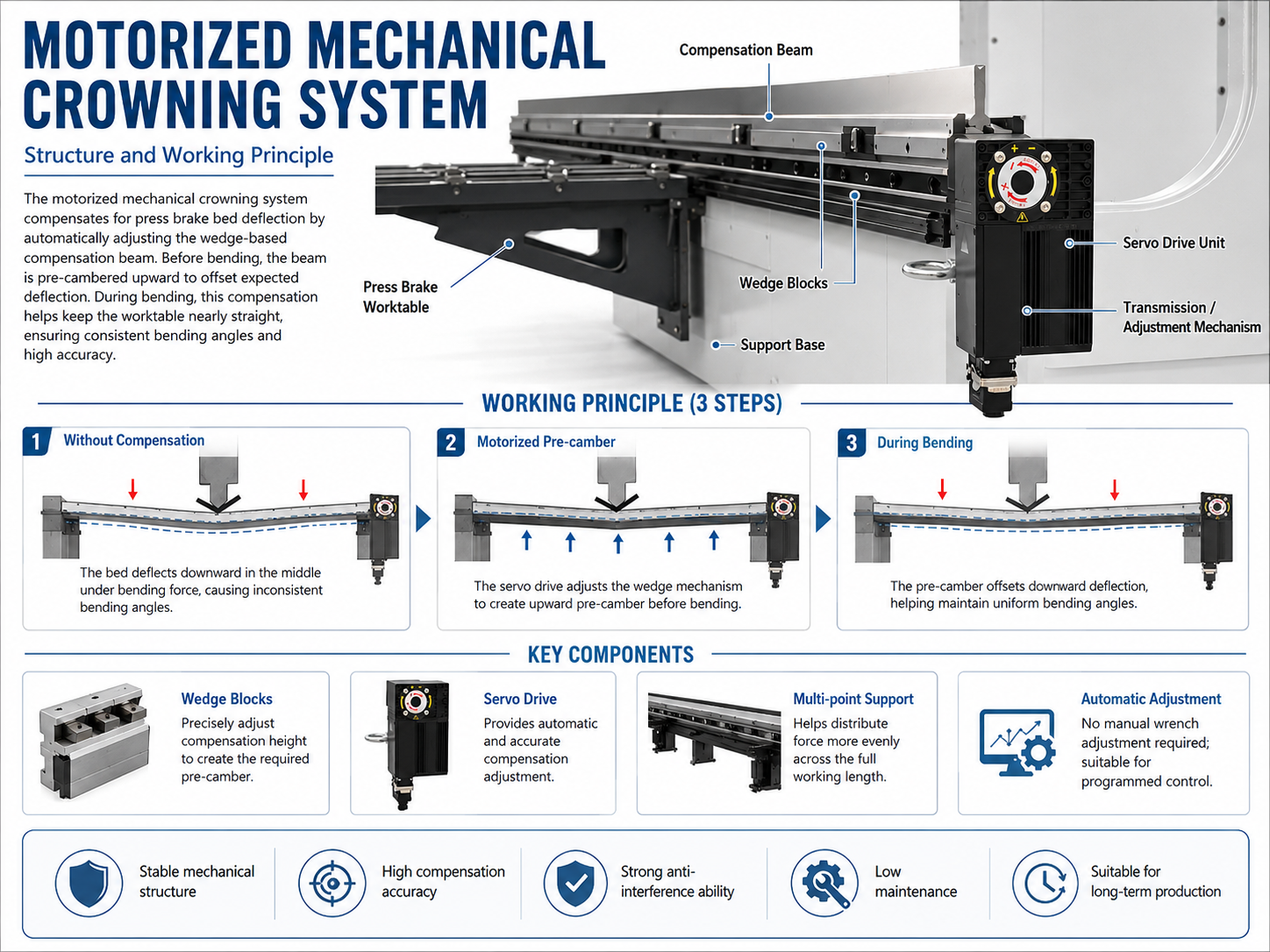
Mechanical crowning is a mature and widely used fundamental crowning solution in electro-hydraulic press brake systems. It uses a wedge-block structure to apply a pre-camber to the worktable, precisely pre-correcting frame deflection before bending, so that stable and consistent machining accuracy can be maintained under load.
This solution features a simple yet highly reliable structure, offering long-term stability, strong anti-interference capability, and excellent repeatability. It is particularly suitable for long-term batch production in standard and heavy-duty electro-hydraulic press brake environments. In many industrial applications, mechanical crowning remains one of the mainstream configurations due to its stability and consistency.
Hydraulic crowning adjusts dynamically during the bending process of an electro-hydraulic press brake according to force variations. It offers good adaptability and can handle different sheet thicknesses and complex working conditions. However, its system structure is relatively more complex and requires higher hydraulic stability, making it suitable for applications that require a certain level of process flexibility.
CNC crowning automatically calculates and adjusts the compensation value through the CNC system, enabling high-precision closed-loop control. It is suitable for electro-hydraulic press brake applications that require high accuracy and consistency in automated production environments, but it also comes with higher cost and system complexity.
4. Comparison Table
| Type | Stability | Accuracy | Maintenance Cost |
| Mechanical Crowning | Very Stable | Good | Low |
| Hydraulic Crowning | Normal | Good | Medium |
| CNC Crowning | Relies most on system control stability | Very High | High |

5. Why Do Many Users Choose Mechanical Crowning in Electro-Hydraulic Press Brakes
In different crowning solutions for electro-hydraulic press brakes, hydraulic crowning and CNC crowning each offer advantages in dynamic adjustment accuracy. However, mechanical crowning remains a widely used solution due to its structural stability and long-term consistency.
Mechanical crowning is typically installed on the press brake worktable using wedge or segmented structures. It is manually or mechanically adjusted to create a pre-camber effect, ensuring precise compensation of frame deflection before bending. This allows the machine to maintain high parallel accuracy between the ram and the worktable during operation.
Because it is a purely mechanical structure, mechanical crowning does not rely heavily on hydraulic or electronic control systems. As a result, it delivers excellent stability, strong anti-interference capability, and consistent repeatability over long-term operation, making it highly suitable for batch production environments in electro-hydraulic press brake applications.
6. Conclusion
Different crowning systems each have their own characteristics and are suitable for different production requirements, accuracy levels, and processing environments. In actual machine selection, a comprehensive evaluation should be made based on the specific application scenario in order to choose the most suitable electro-hydraulic press brake solution.
Welcome to contact LIANGJI. We provide customized electro-hydraulic press brake solutions for different applications, with mechanical crowning as the standard configuration.