
I.Understanding Press Brake Backgauge Positioning Inaccuracy
Inaccurate backgauge positioning is a common issue in sheet metal bending. Typical signs include inconsistent flange lengths within the same batch, the X-axis failing to reach the programmed position accurately, or dimensional deviations gradually developing during continuous production.
These problems do not necessarily indicate a CNC system failure. They may instead be related to the overall condition and performance of the backgauge system.
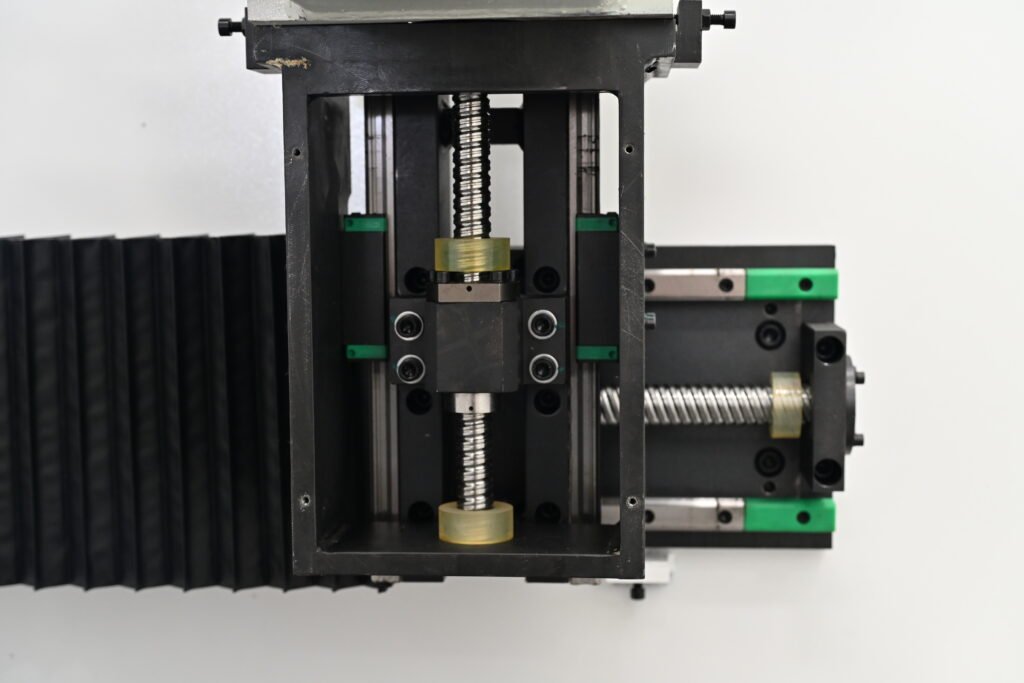
The backgauge is used to precisely position the sheet metal before bending. Based on the programmed flange dimension, the CNC system controls the backgauge movement, and the sheet is placed against the backgauge fingers before bending. The X-axis controls front-to-back positioning and directly determines the flange length. More advanced backgauge systems may also include the R-axis for vertical movement, Z1/Z2 axes for independent lateral movement of the backgauge fingers, and X1/X2 axes for independent front-to-back positioning.


If the actual backgauge position does not match the position programmed in the CNC system, or if it cannot consistently reach the required position, dimensional errors may occur in the finished parts.
This article explains the common causes of inaccurate backgauge positioning, troubleshooting methods and solutions, and how to maintain stable positioning accuracy over the long term
II. What Are the Signs of Backgauge Inaccuracy?
In many cases, reduced backgauge positioning accuracy will not immediately stop the machine, but it can directly affect the dimensions of finished parts.
Common signs include:
- Inconsistent flange lengths on identical parts;
- Actual dimensions differ from the values programmed in the CNC system;
- The first part is accurate, but dimensions gradually deviate during batch production;
- The X-axis frequently stops before or beyond the target position;
- The final position differs when approaching the same target from different directions;
- Frequent manual X-axis compensation is required;
- Positioning accuracy decreases after extended operation;
- Abnormal vibration or noise occurs during backgauge movement.
III. Common Causes, Troubleshooting & Solutions
Reason 1: Ball Screw Wear or Excessive Backlash
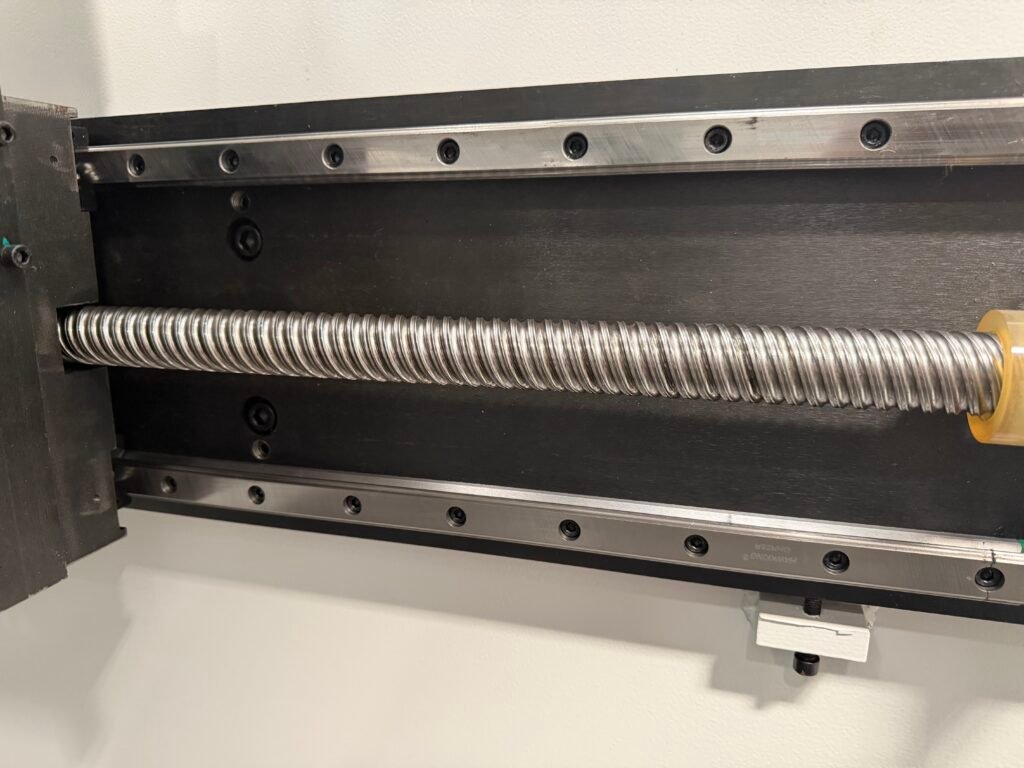
The ball screw is responsible for converting the rotary motion of the servo motor into the precise linear motion of the backgauge. The most common issue is that after long-term machine operation, wear between the screw and the nut can create additional clearance, commonly referred to as increased backlash. This leads to X-axis positioning errors, thereby reducing overall positioning accuracy.
Additionally, factors such as insufficient lubrication, metal dust or impurities entering the transmission system, and misalignment between the servo motor and the ball screw can accelerate screw wear and further impact precision.
When positioning deviations occur, you should first use appropriate precision measuring tools to verify the actual position of the backgauge. After that, further inspect the ball screw, nut, support bearings, and coupling for excessive clearance, wear, or installation abnormalities.
Reason 2: Linear Guide Rail Wear, Contamination, or Misalignment
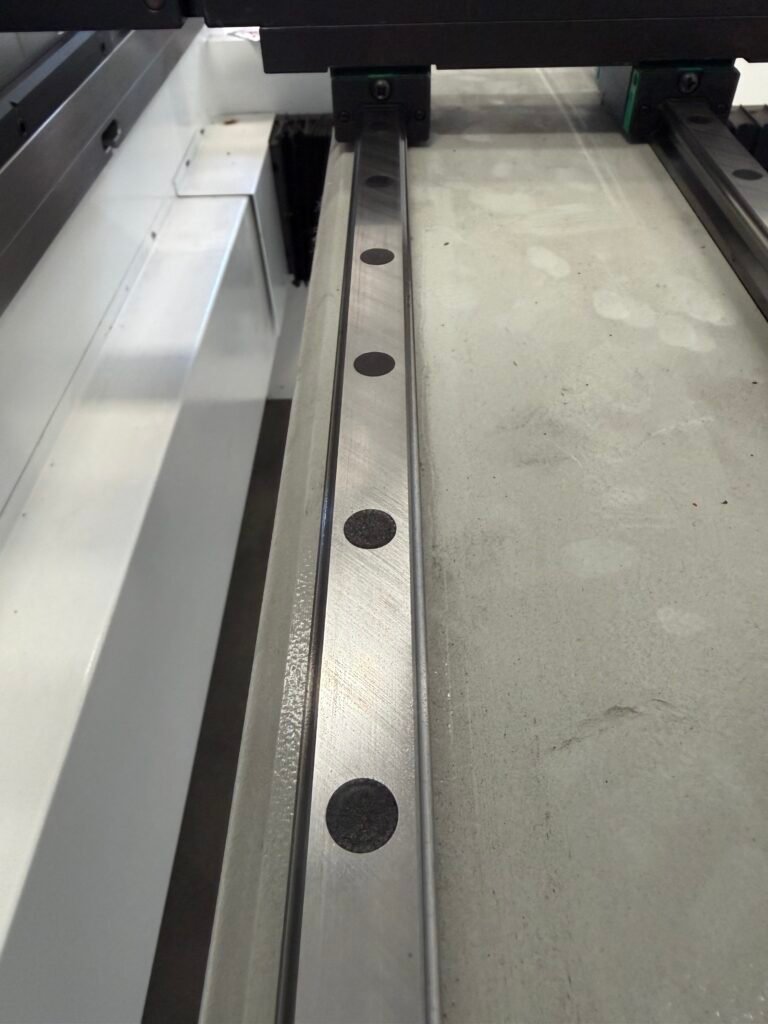
If the ball screw is responsible for the “drive,” the linear guide rail ensures that the backgauge moves smoothly along the correct path.
When the linear guide rail suffers from wear, contamination, or insufficient lubrication, the backgauge may experience stuttering movements, increased mechanical resistance, or abnormal vibration and noise during high-speed operation, which directly impacts the X-axis positioning accuracy.
When encountering such issues, first clean the guide rails and verify their lubrication status. If the movement remains unsmooth after cleaning and lubricating, further inspect the guide blocks (sliders) for wear or excessive clearance. For guide rail components that have been repaired or replaced, you must also re-verify the parallelism and installation accuracy of the rails.
Reason 3: Servo System or Encoder Feedback Abnormalities
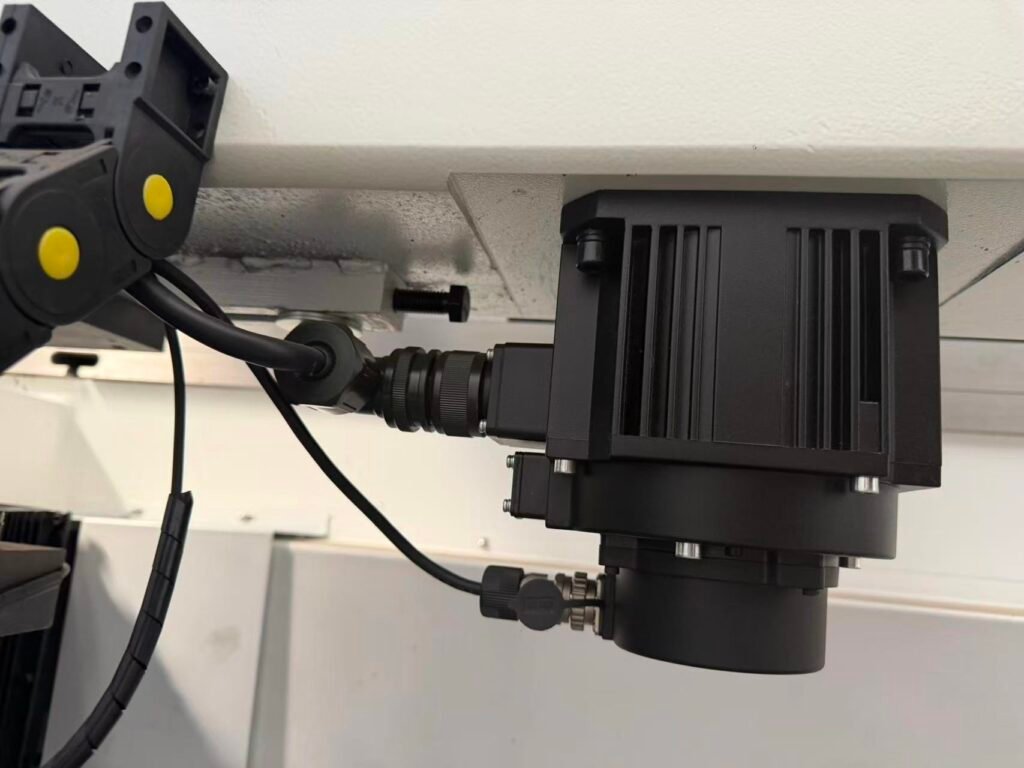
Modern CNC press brakes typically utilize servo systems to control backgauge positioning. After the CNC system issues a command, the servo drive controls the motor’s movement. Meanwhile, an encoder—usually integrated into or mounted on the servo motor—provides real-time feedback on the motor’s position and rotational speed. This forms a Closed-Loop Servo Control System to achieve precise position control.
When servo parameters are configured incorrectly, the drive malfunctions, or the encoder and its feedback signals fail, the system may be unable to accurately determine and control the backgauge’s position. This can lead to X-axis positioning deviations, erratic movement, reference point errors, or servo alarms.
When troubleshooting these issues, you should first check the alarm and diagnostic information on the servo drive. Focus your inspection on the servo parameters, encoder feedback, the motor itself, feedback cables, and all related electrical connections.
Reason 4: CNC Parameter Errors
Backgauge positioning errors can also originate from incorrect axis parameters or reference position settings within the CNC system.
These types of issues typically occur after system upgrades, machine maintenance, or the replacement of servo components.
When troubleshooting such problems, operators should compare the current parameters with the original factory data, focusing on verifying the X-axis offset, reference position, and related motion parameters. Always ensure a complete system backup is made before modifying any critical parameters.

Reason 5: Issues with the Backgauge Fingers
Since the sheet metal must rest directly against the positioning surface of the fingers before bending, any wear, deformation, looseness, or misalignment between the left and right fingers can result in dimensional deviations in the final bend. This will occur even if the X-axis itself is positioned perfectly accurately.
Therefore, operators should routinely clean and inspect the contact surfaces of the fingers, verify that the left and right fingers are aligned to the same reference position, and promptly adjust or replace any components showing signs of wear or deformation.

Reason 6: Mechanical Looseness in the Transmission System and Lack of Maintenance
Vibrations generated from long-term operation can cause components such as couplings, bearings, and fixing bolts to become loose or worn. This prevents the servo motor’s movement from being accurately transmitted to the backgauge. At the same time, insufficient lubrication will increase friction and wear on the ball screw and linear guide rails, further degrading motion stability.
To maintain the long-term, stable positioning accuracy of the backgauge, it is essential to regularly inspect key mechanical connections and transmission components, maintain proper cleanliness and lubrication, and promptly tighten or replace any abnormal parts.

IV. How Does LIANGJI Improve Long-Term Backgauge Positioning Accuracy?
The LIANGJI Performance Series electro-hydraulic CNC press brake features the Center-Drive™ Precision Backgauge System, which is designed to ensure both high-speed positioning and long-term mechanical stability.
Rather than relying solely on high-performance servo motors to improve accuracy, it achieves precision by optimizing the entire mechanical transmission structure.
The system primarily includes the following design features:
- Center-Drive™ central ball screw layout
- HIWIN / TBI dual linear guide rails
- 10 mm thick, 200 mm heavy-duty backgauge beam
- Fully enclosed protection for the R-axis
- Z1/Z2 backgauge fingers
- High-hardness fingers (HRC 55–60)