
In sheet metal fabrication, inaccurate bending angles are a frequent challenge. This issue not only compromises product quality but also increases rework costs and hampers production efficiency. We have summarized the 10 most common causes and their solutions to help you troubleshoot and resolve these issues quickly.
1. Material Springback
During bending, metal deforms under force, but once the pressure is released, the material’s elasticity causes it to “spring back” slightly. This results in an actual angle that is larger than the target angle. Different materials exhibit varying degrees of springback; for example, stainless steel has significant springback, while low-carbon steel is relatively minimal.
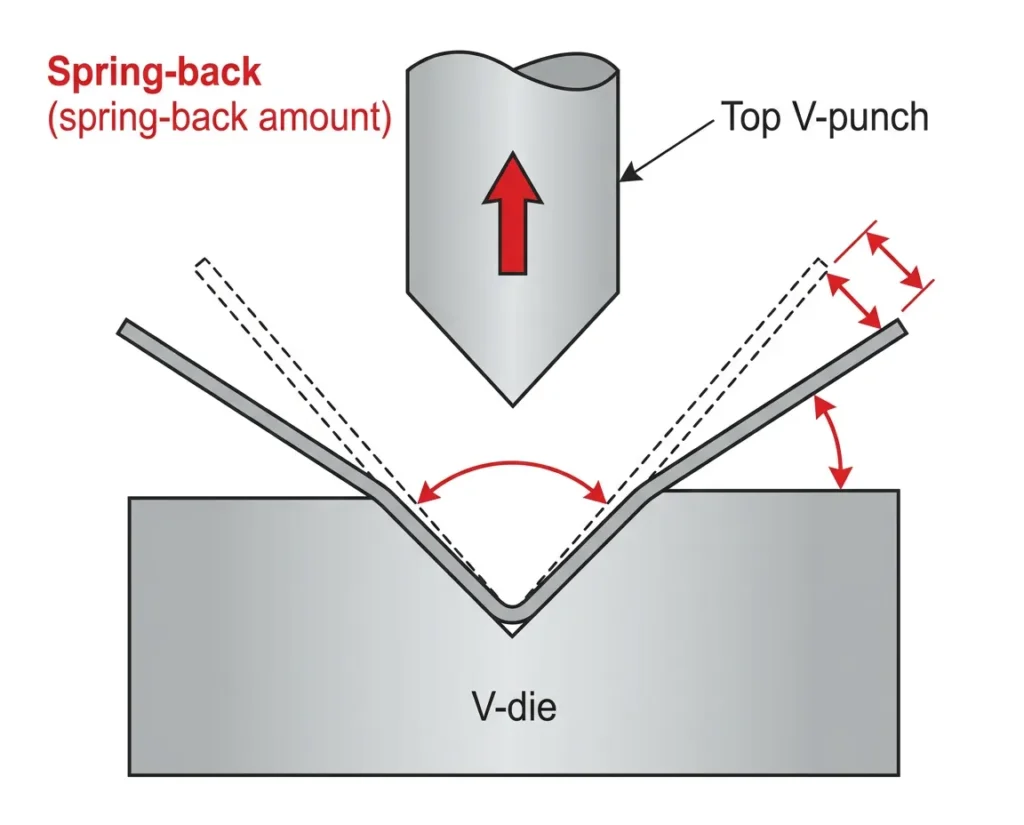
- Solution: Perform test bends to measure springback before mass production and apply overbending to compensate. Additionally, utilize the CNC system’s angle compensation feature to ensure consistency throughout the run.
2. Inconsistent Material Thickness
Since the required bending pressure is directly tied to plate thickness, even minute variations can lead to angle discrepancies under the same settings. Thicker plates tend to be under-bent (larger angles), while thinner plates are prone to over-bending.
- Solution: Measure material thickness before processing and try to use the same batch of material for a single production run to minimize thickness-related errors.
3. Improper V-Die Selection
The width of the lower V-die opening directly affects the force distribution. If the V-opening is too large, the plate lacks sufficient support, increasing springback and leading to larger angles. If it is too small, the pressure becomes too concentrated, which can cause over-bending or surface marking.
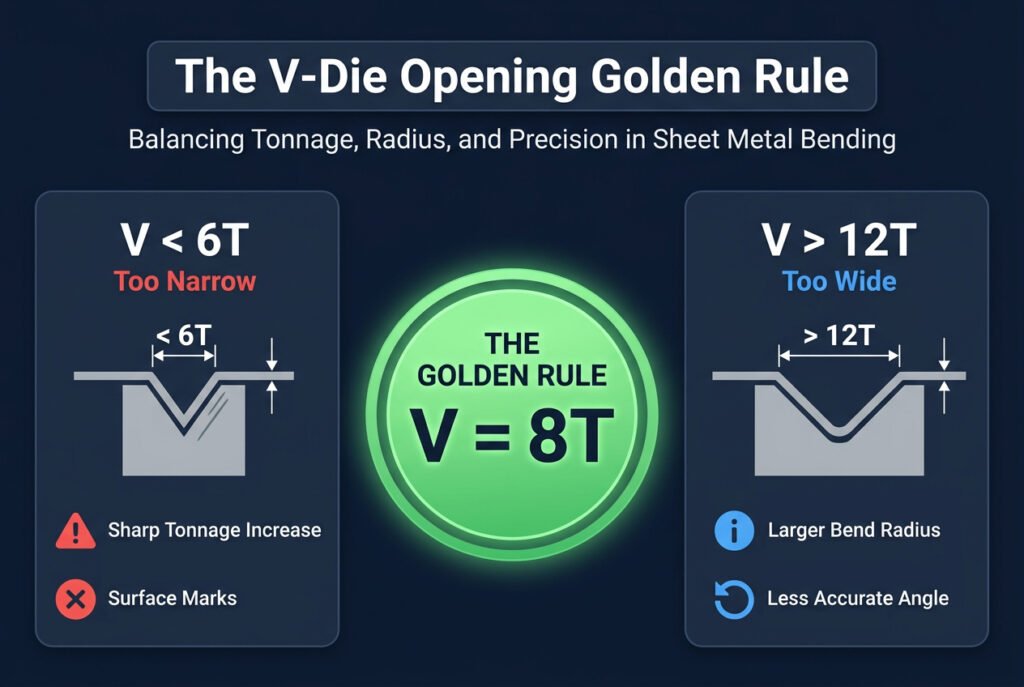
- Solution: Ideally, the V-opening width should be 6–8 times the material thickness. Choose the die according to the material type and thickness to ensure forming quality.
4. Tooling Wear and Tear
Over time, the edges of the punch and die will dull or wear down. This changes the standard contact geometry between the tool and the metal, directly impacting the final angle.
- Solution: Regularly inspect the condition of your tooling. Regrind or replace worn components to maintain high precision.
5. Incorrect Bending Pressure Settings
Improper tonnage settings are a direct cause of angle issues. Insufficient pressure results in the plate not being fully formed (under-bending), while excessive pressure leads to over-bending.
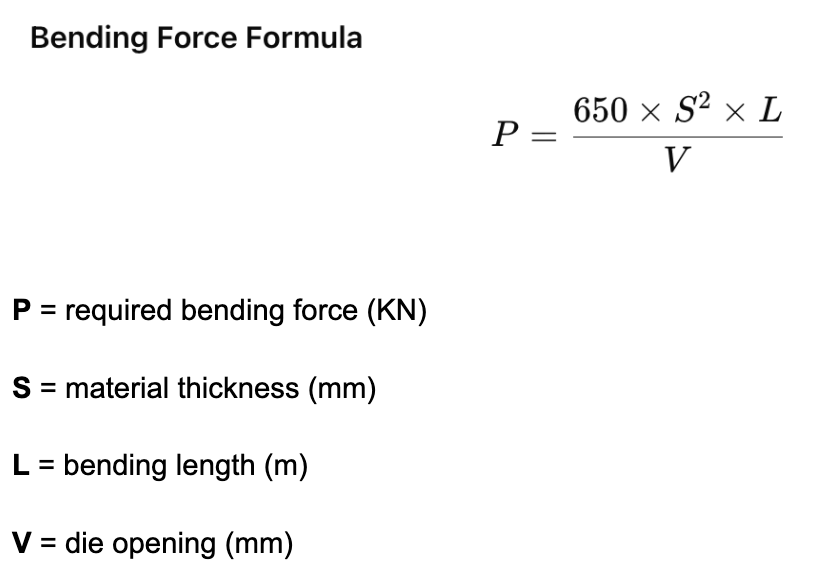
- Solution: Calculate the required tonnage based on material properties and thickness. Always perform a first-article test to fine-tune the pressure settings before proceeding.
6. Incorrect Deflection Compensation (Crowning)
Under high pressure, the press brake frame naturally deflects, causing the center of the machine to bow slightly. This leads to a “canoeing” effect where the angle in the middle of a long workpiece is different from the ends.
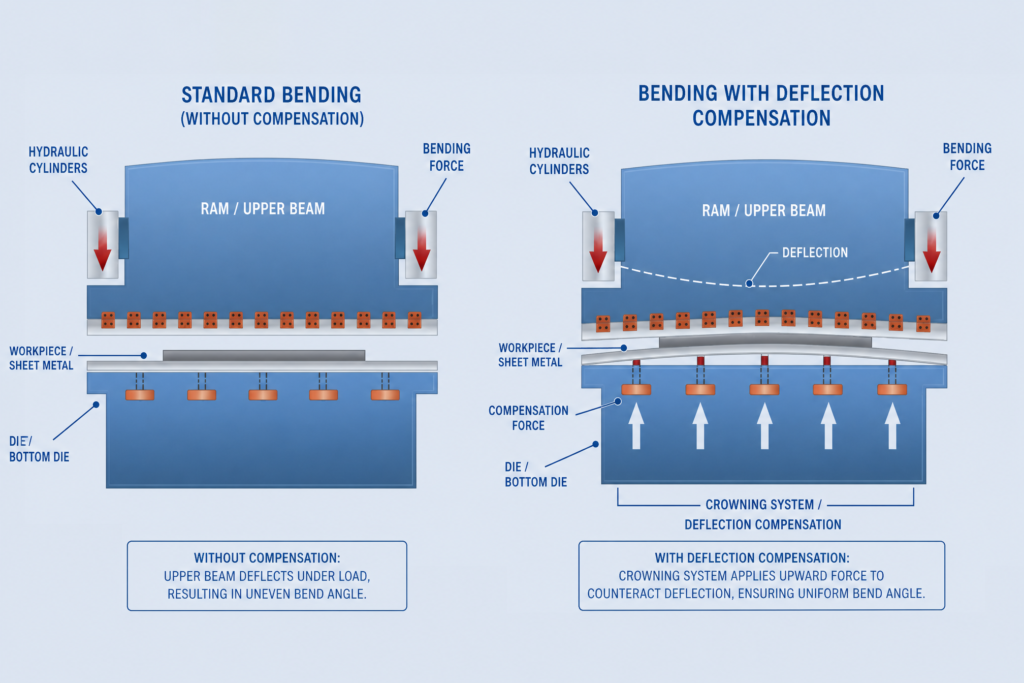
- Solution: Use a Crowning system (deflection compensation). This provides an opposing force to ensure the punch and die remain parallel during the stroke, guaranteeing a uniform angle across the entire length.
7. Inaccurate Backgauge Positioning
The backgauge determines the position of the bend line. If it is misaligned, the bend will occur at the wrong location, causing angle deviations.
- Solution: Periodically calibrate the backgauge system and ensure its repeatability remains within tolerance. Check for loose mechanical components that might affect positioning.
8. Ram Non-Synchronization
The press brake ram must descend evenly on both the left and right sides. If one side moves ahead or deeper than the other, the angles will vary across the workpiece. This is common in older machines or those using torsion bar synchronization.
- Solution: Regularly check the synchronization system. If possible, upgrade to a machine with an electro-hydraulic servo system for superior precision and Y1/Y2 axis control.
9. Operator Error
Variations in how different operators handle the material—such as not holding the plate flush against the die, unstable support, or slight skewing—can cause the bend line to shift.
- Solution: Standardize operating procedures and provide training. Use auxiliary positioning tools like side stops, front supports, and backgauges to ensure every piece is loaded correctly.
10. Temperature and Environmental Factors
During extended operation, the machine generates heat, which can lead to subtle thermal expansion in the frame. Additionally, material properties can shift slightly with temperature changes. While often negligible, these factors become critical in high-precision work.
- Solution: Maintain a stable workshop environment whenever possible. Perform periodic re-calibrations throughout the day if the machine has been running continuously for long periods.